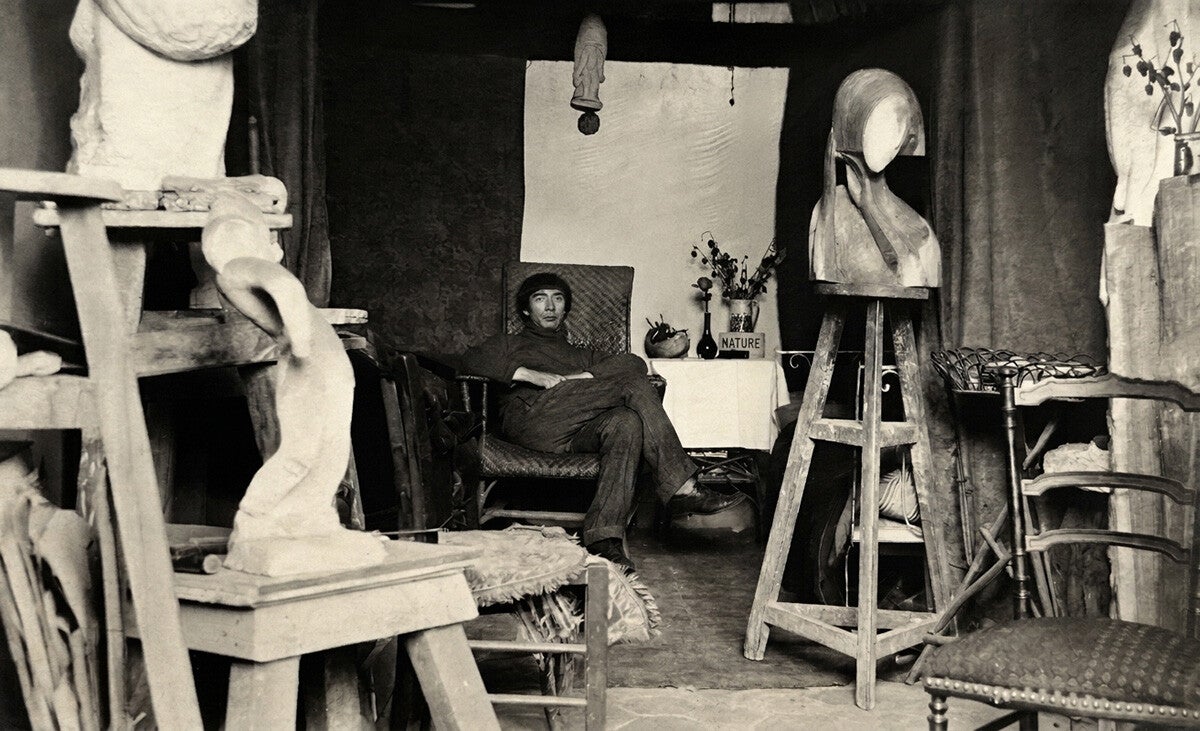
Ossip Zadkine in His Paris Studio, Circa 1913
This black-and-white photograph captures a young Ossip Zadkine seated inside his modest Paris studio on 114 Rue de Vaugirard around 1913. Taken during a pivotal era in modern art history, the image provides an intimate glimpse into the environment that shaped one of the twentieth century’s most influential sculptors.
The Artist and the Composition
Positioned near the center of the frame, the Russian-born artist sits relaxed in a woven armchair, his legs crossed and hands resting calmly on his lap. Wearing a dark, high-necked sweater and trousers, Zadkine looks directly toward the camera with a composed, contemplative expression. A bright white sheet pinned to the dark wall behind him acts as a makeshift backdrop, framing his silhouette and creating a strong visual contrast against the shadowed, cavernous interior of the workspace.
A Laboratory of Early Modernism
The studio is densely packed with the raw materials, furniture, and works-in-progress that defined Zadkine’s early Parisian period.
Emerging Cubist Forms: On a tall, four-legged wooden stand to the right rests a stylized, faceted bust. Its simplified, angular planes reflect Zadkine’s growing engagement with Cubism and non-Western art, signaling his departure from traditional academic modeling toward geometric abstraction.
Carving and Modeling: In the left foreground, a smaller, fluid plaster figure stands atop a sturdy wooden stool, while a larger, unfinished white torso sits perched on an elevated shelf above it. Above the artist's head, a small vertical figure hangs suspended from the ceiling, demonstrating how every inch of the cramped room was utilized for creation and storage.
Everyday Bohemian Details: To the right of Zadkine's chair, a small table draped in a white cloth holds a dark bottle, a patterned vessel filled with dried branches, and a small sign reading "NATURE." In the right foreground, a wooden chair with an upholstered seat and a wire basket complete the lived-in, utilitarian atmosphere.
Historical Context in Montparnasse
Around 1913, Zadkine was in his early twenties and had recently transitioned from living at La Ruche ("The Beehive")—the legendary, low-rent artists' colony in Montparnasse—to a studio on Rue de Vaugirard. This move placed him at the geographic and intellectual center of the Parisian avant-garde, just steps from famous gathering spots like Café de la Rotonde.
During these formative years, Zadkine immersed himself in a vibrant international community of immigrant artists, forming close friendships with figures such as Amedeo Modigliani, Marc Chagall, Alexander Archipenko, and Chaim Soutine. Operating on very limited financial means, he frequently worked with salvaged blocks of wood and stone, pioneering a return to taille directe (direct carving).
This photograph freezes a moment just before Zadkine's major critical breakthrough at the 1913 Salon d'Automne. Surrounded by the quiet intensity of his nascent sculptures, the young artist appears poised on the threshold of international recognition, fully embedded in the bohemian creative ferment of pre-war Paris.